


Smartphone Pinky: Causes, Symptoms, and How to Fix It
This guide covers at-home diagnosis and self-treatment for mild-to-moderate smartphone pinky. It does not address cases involving severe nerve damage, muscle wasting, or loss of grip strength those need an in-person evaluation.
What Is Smartphone Pinky?
Smartphone pinky refers to pain, numbness, stiffness, or a visible indentation in the little finger caused by resting the weight of a phone on it during extended use. It isn’t a formal medical diagnosis — you won’t find it in a textbook — but the underlying mechanisms are real and well-documented.
Here’s the short version: when you hold a phone one-handed, your pinky acts as a shelf. The other fingers tap and swipe; the pinky bears the load. Do that for a few hours a day, and the soft tissue around the base joint compresses, the ulnar nerve gets irritated, and you end up with everything from a dull ache to a finger that goes numb at 2 AM.
According to a 2024 study published in BMC Public Health, close to 60% of frequent smartphone users report hand pain, and the pinky is among the most commonly affected fingers. That’s not a fringe problem. That’s most people who use a phone for more than a couple of hours a day.

Why Does Your Pinky Hurt From Holding Your Phone?
There are three main reasons, and they’re not all the same thing.
1. Soft Tissue Compression (The Dent Problem)
The visible dent people panic about — usually on the middle bone of the pinky — is almost always soft tissue compression, not bone deformation. The phone edge presses into the same spot repeatedly, day after day, and the skin and underlying tissue mold around it. Think of it like sleeping on your hand.
Good news: for most people, this is reversible. Change the grip, give it time.
Or maybe I should say it this way the dent looks alarming, but behaves more like a pressure mark than a structural injury. Permanent bone reshaping has been reported in a 2024 study by Demirkran et al. in users spending more than four hours daily on their phones, but that’s the end. For casual-to-moderate users, the dent typically fades within weeks once the pressure source is removed.
2. Ulnar Nerve Irritation (The Numbness Problem)
The ulnar nerve runs from your neck down through the elbow and into your ring and pinky fingers. It’s the same nerve you hit when you bang your “funny bone.” When you hold a phone with your elbow bent — which is almost everyone’s default posture — that nerve gets stretched and compressed simultaneously.
Studies show phone use places roughly a 69% increase in strain on the ulnar nerve during a standard call posture. Six minutes of sustained elbow flexion is enough to trigger measurable changes.
A 2021–2024 retrospective study published in the Journal of Clinical Medicine found that 82% of cubital tunnel syndrome patients reported using their phones with the elbow flexed, versus only 56% of controls — and critically, it wasn’t total usage time that mattered most. It was posture. That’s the counter-intuitive finding most people miss.
Quick note: cubital tunnel syndrome is the clinical name for what happens when this nerve compression becomes chronic. “Cell phone elbow” is the colloquial version. Smartphone pinky and cubital tunnel syndrome often overlap you might have both.
3. Trigger Finger / Tendon Inflammation (The Stiffness Problem)
If your pinky clicks, catches, or gets stuck in a bent position, that’s a different issue: trigger finger. The tendon at the base of the finger becomes inflamed from repetitive small movements — texting, scrolling — and gets trapped in its protective sheath. It’s less common than nerve irritation, and the treatment path is different.
Symptoms: What Smartphone Pinky Actually Feels Like
The first signs are usually pain and stiffness at the base of the pinky joint after a long session on the phone. But the symptom picture varies depending on what’s going on:
| Symptom | Most Likely Cause | Urgency |
| Dent or indentation on pinky | Soft tissue compression | Low — usually reversible |
| Numbness/tingling, especially at night | Ulnar nerve irritation | Moderate — address within weeks |
| Clicking or catching when bending finger | Trigger finger (tendon) | Moderate — may need PT |
| Weakness in grip or pinch | Cubital tunnel syndrome | High — see a doctor |
| Pain radiating up the forearm | Nerve or tendon strain | High — see a doctor |
Quick Comparison Cubital Tunnel vs. Carpal Tunnel: Cubital tunnel affects the ulnar nerve at the elbow; symptoms appear in the ring and pinky fingers. Carpal tunnel affects the median nerve at the wrist; symptoms appear in the thumb, index, and middle fingers. They feel similar both produce tingling and numbness but the anatomy is different and so are the treatments.
How to Fix Smartphone Pinky at Home
Most mild-to-moderate cases respond well to self-treatment. Here’s what physical therapists actually recommend not a generic “rest and stretch” list, but a sequenced approach.
To treat smartphone pinky at home, follow these steps:
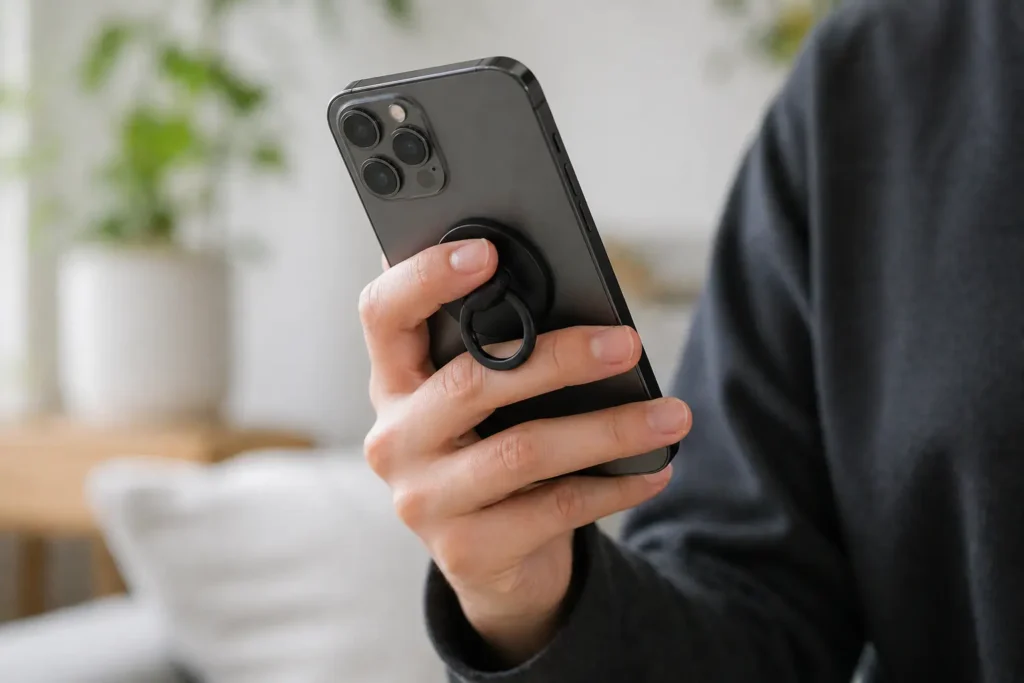
- Change your grip immediately use a PopSocket or phone ring to shift weight off the pinky
- Do ulnar nerve glide exercises twice daily (see below)
- Apply heat for nerve symptoms (tingling/numbness) or alternate warm/cool water soaks for 5 minutes
- Take OTC anti-inflammatories like ibuprofen or apply Voltaren Gel (diclofenac) topically for localized pain
- Avoid sleeping with your elbow bent — use a straight arm splint if needed at night
The Exercises That Actually Help
Look if you’re dealing with the numbness version rather than the dent version, here’s what actually works.
Ulnar Nerve Glide: Extend your arm out straight, wrist bent back (fingers pointing up), then slowly bend your elbow while keeping that wrist position. Hold 5 seconds, release. Ten reps, twice a day. This mobilizes the nerve along its full path rather than letting it stay compressed in one spot.
Hand Tendon Glide: Start with fingers straight, curl them into a hook (like a claw), then into a full fist, then into a straight fist. Cycle through slowly, ten times. This keeps tendon tissue from stiffening.
Elbow Curl with Wrist Extension: Bend and straighten the elbow slowly while keeping the wrist extended backward. Targets the nerve at the precise location where phone use compresses it.
Hinge Health a telehealth physical therapy platform has a specific smartphone pinky protocol built around these three movements, and their members report an average 68% reduction in pain within 12 weeks.
Disclaimer: These exercises are for educational purposes. If symptoms worsen or you develop significant weakness, consult a healthcare provider.
What About the Dent? Will It Go Away?
Yes — for most people, it will.
I’ve seen conflicting data on this: some sources treat the indentation as purely cosmetic and reversible, others (particularly Demirkran et al., 2024) document radiological changes in the fifth finger’s bone in heavy users. My read is this: the dent that appears after a few months of heavy phone use is almost always soft tissue and disappears within 4–8 weeks of habit change. If the indentation is deep, has been there for years, and you use your phone 6+ hours daily, it warrants an X ray.
The honest answer: Most people who are anxious about the dentist have the reversible kind. But don’t let that reassurance prevent you from changing the behavior the nerve damage risk that builds underneath is the bigger problem.
Prevention: The Grip Changes That Actually Matter
This is where most articles go vague. Here are specific, tested changes:
PopSocket or phone ring grip. Attaching a PopSocket to the back of your phone lets you loop a middle finger through it, completely removing the pinky from the support role. This one change eliminates the primary mechanical cause.
Two-handed use. Research consistently shows that two-handed phone use distributes the load and significantly reduces ulnar nerve strain. Most people resist this because it feels slower — it isn’t, after a week of habit formation.
Forearm support. When texting, rest your forearm on a surface. This keeps the elbow close to 90 degrees or straighter, dramatically reducing pressure on the cubital tunnel. A 2012 study in the journal Work specifically documents this as one of the most effective ergonomic interventions for phone-related hand problems.
Screen time thresholds. There’s no official “safe” daily limit, but the Demirkran et al. study found structural changes primarily in users exceeding four hours of active one-handed holding daily. If you’re under two hours, your risk is low. Between two and four hours with a correct grip: manageable. Over four hours, one-handed, daily: you need a grip accessory, not just stretches.
When to See a Doctor
Some experts argue that smartphone pinky is mostly a self-limiting condition that resolves with habit change. That’s valid for mild cases. But if you’re dealing with persistent weakness, you need professional evaluation.
Specifically, see a doctor or orthopedic specialist if:
- Grip or pinch strength has noticeably decreased
- Numbness is constant rather than intermittent
- You have muscle wasting in the hand (the space between thumb and index finger looks hollowed out)
- Symptoms haven’t improved after 6–8 weeks of consistent home treatment
At that point, you’re likely dealing with established cubital tunnel syndrome, not just soft tissue irritation, and the treatment pathway changes significantly.
Frequently Asked Questions
Change your grip first use a PopSocket to take weight off the pinky. Then do ulnar nerve glide exercises twice daily and apply heat for numbness. Most mild cases improve within 4–8 weeks.
For most users it isn’t — soft tissue indentations from phone pressure typically reverse within weeks of changing habits. Permanent structural changes are primarily documented in people holding phones more than four hours daily over years.
Not immediately for mild pain or a dent. See a doctor if grip strength drops, numbness becomes constant, or symptoms don’t improve after 6–8 weeks of consistent home treatment.
Nighttime numbness usually means the ulnar nerve is irritated. Many people naturally bend their elbows while sleeping, which compresses the nerve further. A simple elbow splint worn at night often resolves this.
You don’t need to stop — you need to change how you hold it. Switch to a two-handed grip or add a phone ring. Complete rest is rarely necessary unless you have trigger finger with a catching sensation.

